
Blog - Latest News

Stage 3 Income Tax Cuts

The Labor Government has announced changes to the ‘Stage 3’ income tax cuts introduced by the Morrison Government.  The previously legislated tax cuts removed the 37% tax bracket for individuals earning between $120,001 to $180,000, and increased the threshold from where the top marginal tax rate applies to $200,000.  This proposal had the effect of flattening the marginal tax rate to 30% for those earning between $45,001 to $200,000.

However, the Labor Government has proposed the following changes from 1 July 2024:

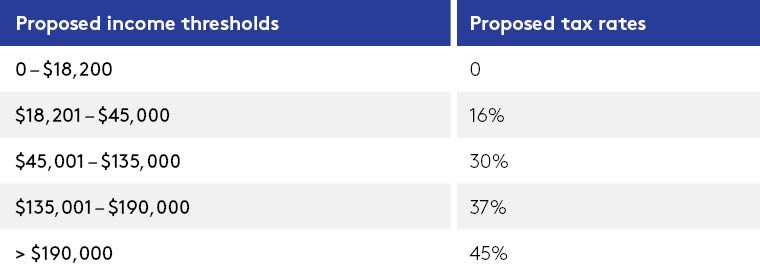
  • Reducing the 19% tax rate to 16% for incomes between $18,200 and $45,000.
  • Reducing the 32.5% tax rate to 30% for incomes between $45,001 to a new $135,000 threshold
  • Increasing the threshold at which the 37% tax rate applies from $120,000 to $135,000.
  • Increasing the threshold at which the 45% tax rate applies from $180,000 to $190,000.

The proposed changes to thresholds and rates (excluding the 2% Medicare levy) are as follows:
The proposed changes give rise to tax planning opportunities.  One example is the timing of concessional (tax-deductible) superannuation contributions.  With the proposed tax rate for those earning between $18,200 and $45,000 dropping from 19% to 16%, the tax effectiveness associated with extra concessional superannuation contributions reduces.  As a result of this, it could be more tax effective for you to make an additional superannuation contribution before 30 June 2024.

Salary Packaging

The proposed changes will affect some employees who have salary packaging arrangements with not for profit (NFP) organisations, but this will depend on their employer’s status for fringe benefits tax (FBT) purposes.  If you work for an NFP organisation that is a ‘rebatable’ FBT employer then from 1 July 2024 you should only package ordinary benefits (such as expense payments) if your taxable income is greater than $135,000.  This is because the effective FBT rate will be less than the marginal tax rate that applies to income above this threshold.

If you have any questions or concerns about these changes, please do not hesitate to contact us, or view the changes on the Taxation Office website.

Simon Dinér's Articles

ATO Draft Ruling TR 2025/D1 – What Property Owners Need to Know

The Australian Taxation Office (ATO) has released a new draft ruling, TR 2025/D1, which reshapes how income and deductions from holiday homes are treated. This includes traditional long-term rentals, holiday homes, and short-term accommodation platforms like Airbnb.    What’s Changing?  The draft ruling replaces the decades-old IT 2167 and reflects the ATO’s updated stance on […] Read more

EOFY 2025 Tax Planning Tips for Individuals

As 30 June 2025 draws near, it’s the perfect time to get your year-end tax planning in order. Taking proactive steps now can help you maximise deductions, meet compliance obligations and reduce your tax bill.  This article covers essential EOFY 2025 tax tips for individuals to help you finish the financial year with confidence and […] Read more

Year End Tax Tips for Individuals and Businesses

June 2024 The end of the financial year is fast approaching. But there is still time to put in place those last minute tax planning strategies. For individuals, this can include superannuation contributions, donations and making sure you have the right record keeping for motor vehicle and home office claims. For businesses, temporary full expensing […] Read more

Murray Nicholls's Articles

Offering Employees of PBIs Salary Sacrificed Benefits

If you’re an employer in the not-for-profit or community services sector and registered as a Public Benevolent Institution (PBI), you have a powerful tool to attract and reward your workforce: salary sacrificed benefits.  What is a PBI salary sacrifice arrangement? A PBI salary sacrifice arrangement (also known as a salary packaging arrangement) allows employees to use part of their pre-tax […] Read more

ATO Guidance on Employee versus Contractor Status

As a result of two recent High Court cases in relation to employment law, the Australian Taxation Office (ATO) has released two documents to provide guidance on whether a worker engaged by a business is an employee or a contractor. Taxation Ruling The first document is taxation ruling TR 2023/4, which outlines the ATO’s view […] Read more